
Protecting Neighborhood Livability While Welcoming Park Visitors
- Derrith Schmidt

- Jul 9
- 6 min read
Updated: Jul 17
How the City of Lake Oswego can be "Good Neighbors" to Old Town residents.

The Festival of the Arts Showed What's Possible.
Let's Build on the Festival's Success.
The 2026 Lake Oswego Festival of the Arts demonstrated that thoughtful traffic and parking management can improve both visitor safety and neighborhood livability.
Recognizing that the streets surrounding George Rogers Park cannot accommodate large numbers of parked vehicles, Festival organizers worked with the City to implement a comprehensive traffic and parking plan. The result was a safer and more enjoyable experience for visitors while significantly reducing impacts on nearby neighborhoods.
Many of the Festival's strategies—such as remote parking lots and shuttle buses—may not be practical for every busy summer weekend. However, several of the traffic management tools used during the Festival are inexpensive, easy to implement, and could help address the challenges Old Town experiences during the summer.
George Rogers Park Has More Visitors On Hot Summer Days Than Parking Spaces
George Rogers Park has only 121 parking spaces.
Many of those spaces are located near the upper athletic fields, while visitors heading to the beach, lower park, and riverside trail often prefer to park on Old Town neighborhood streets instead. There are only 20 parking spaces at the lower GRP lot plus two handicap spots and two parking spaces for only 5 minute drop-off/pick up.
On warm days and especially on weekends, neighborhood streets effectively become the overflow parking lot for George Rogers Park.
The result is:
streets filled with cars parked everywhere
residents being unable to park themselves in front of their homes
pedestrians walking in roadways that have no sidewalks
cyclists, strollers, dogs, and paddleboarders sharing narrow streets
blocked visibility at intersections
delayed access for emergency vehicles
reduced parking for residents, their guests and service contractors
The City already has experience and success managing these challenges during major events. And Parks & Rec has data on the number of Park visitors from Placer AI.
What Worked During the Festival
Temporary No Parking Areas
For the Festival, temporary "No Parking" signs were installed throughout the neighborhood.
These included:
both sides of Furnace Street from Ladd Street toward Leonard Street
portions of Durham, Church, and Wilbur Streets
the north side of Ladd Street
These temporary restrictions protected intersections, improved pedestrian safety, and ensured residents without garages could still park near their homes.


We would like the City to consider using these same temporary signs during the busiest weekends from July through September. Could the signs be placed and left up July through September?
This is an inexpensive solution that has already proven to be effective.
Resident Parking Passes
Festival vendors received parking permits that identified authorized vehicles.
A similar approach could be used for:
Old Town residents
home health providers
contractors
visitors staying with residents
The City could issue residents and specified others permits and everyone else would not be allowed to park legally. This would help preserve neighborhood access and livability. And this would make it easy for LOPD to know who not to ticket. Neighbors could print their own passes to use in their vehicles.

Better Management When the Parking Lot Is Full
Another successful Festival strategy was actively managing vehicle access.
When George Rogers Park fills on hot summer weekends, vehicles continue entering the park even after every parking space is occupied. This creates unnecessary congestion as drivers reach the bottom of the hill, discover there is nowhere to park, and must turn around while additional vehicles continue entering.
During an emergency at the park over the July 4th weekend, this became especially apparent. A neighbor who took photos of what happened wrote to me, "Throughout this time there was a steady stream of cars trying to enter the lower parking lot. You would think that one fire engine was clue enough to avoid the lot, but once you're in the traffic stream, it's hard to get out."
Read more here:
We understand closing the lot to GRP is difficult because there is no place for people to turn around once on Green Street (with Furnace Street being one-way only into the GRP parking lot). This seems to our OTNA Board something for the City to troubleshoot with the fire department and Park Rangers. When the lower parking lot at GRP is full, how concerned is the Fire Department about getting their trucks and ambulances in and out of the lower parking lot during emergencies? And what solutions would they recommend?
For our neighborhood livability, we request that temporary signs be used such as:
Parking Lot Full
No Parking Available
Lower Parking Lot Closed
These could be placed at Green Street and Ladd Street whenever the lot reaches capacity. These signs could be put out by Park Rangers or Community Service Officers.

Similar traffic management techniques are already used at Sauvie Island during busy periods.


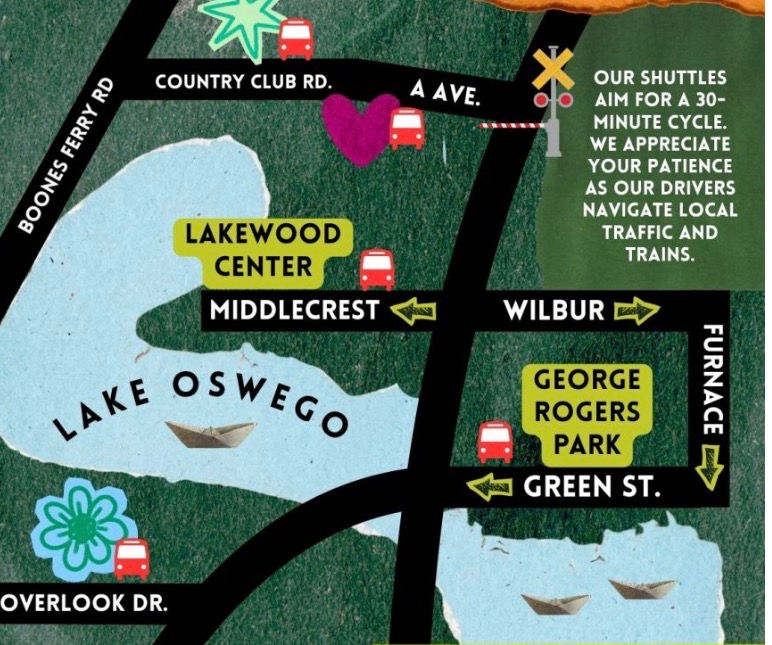
See map below of the traffic flow for the Arts Festival - Park visitors were to enter on Wilbur Street, turn on Furnace to enter the park (and try and find parking) and exit on Green Street to Hwy 43. The real management piece was the control exercised on how vehicles came in and out of the neighborhood. We realize this required people manning the entrances at Green Street and Ladd Street so this is not feasible to implement this summer but perhaps this could be considered for a pilot program for summer 2027. The City place a Park Ranger at the entrance to Oswego Lake last summer and again this summer has someone there part-time to monitor lake access for visitors on paddleboards and kayaks.
Planning Ahead
The Festival transportation plan demonstrates that the City already understands an important reality: There are more visitors on peak days than George Rogers Park has parking spaces.
Rather than relying on neighborhood streets to absorb overflow parking, the Festival used transportation management tools to reduce impacts before problems occurred.
That same proactive approach could benefit George Rogers Park throughout the summer.
Our Recommendations
For the remainder of Summer 2026
We encourage the City to:
place temporary "No Parking" signs in key neighborhood locations and leave them up all summer
continue proactive parking enforcement
close access to the lower parking lot when it is full
offer residents a way to have a print at home permit to place in their vehicles
These are relatively low-cost strategies that the City has already demonstrated can work.
Looking Ahead to Summer 2027
We encourage the City to develop a seasonal traffic and parking management plan for George Rogers Park.
Potential strategies could include:
remote parking lots
pilot shuttle service on peak weekends
improved visitor information
bicycle parking and encouragement
dynamic parking management based on occupancy
Portland Parks & Recreation is currently piloting shuttle service to Forest Park with Metro grant funding, demonstrating that creative transportation solutions can help protect neighborhoods while maintaining public access to popular parks.
The City already knows how to do this because it successfully did it for the Festival. Let's apply the same proven practices during the busiest summer weekends.
Related blog posts:
How Can We Work Together to Balance Public Access and Neighborhood Livability at George Rogers Park? George Rogers Park is one of Lake Oswego’s most valued public spaces. There are only 121 parking spaces. During the summer—especially on hot evenings and weekends—the park regularly exceeds its parking capacity. As a result, Old Town becomes the overflow parking lot, creating significant impacts on neighborhood livability, safety, and access. Our ask of the City Leaders is for a specific one to two year plan to eliminate the strain on Old Town.
What GRP is like in the summer:
Roehr Park for paddleboarding:
The 2002 Master Plan for George Rogers Park
People can park and sleep in their cars in our neighborhood overnight. What are the City's ordinances about this? https://www.oldtownlakeoswego.org/post/what-are-the-city-of-lake-oswego-s-policies-about-abandoned-vehicles-and-vehicles-people-are-living


Comments