
George Rogers Park Master Plan from 2002 Was Sadly Never Funded

The City of Lake Oswego invested two years and a lot of time and money to create a comprehensive "Master Plan" for George Rogers Park that was accepted by the City Council on November 18, 2002. Many of our Old Town Neighbors were involved in collaborating with the City and Atlas Landscape Architects on the development of this plan. One of our neighbors, Susanna Kuo, kept her copy of the large bound document and brought it to our June 2026 neighborhood association meeting to share with us.
I really enjoyed reading it!

Real collaboration among all the "stakeholders" for this master plan.


So many of the problems are the same today as they were outlined then.


The process was comprehensive to involve all stakeholders. The consultant team began with a list of basic improvements.

The Executive Summary

The landscape architecture consulting firm had some creative solutions for how to make George Rogers Park a wonderful park and livable for the neighbors. I've taken photos of pages of the book to include in this post. Enjoy!
Concept A

Concept B

Concept C
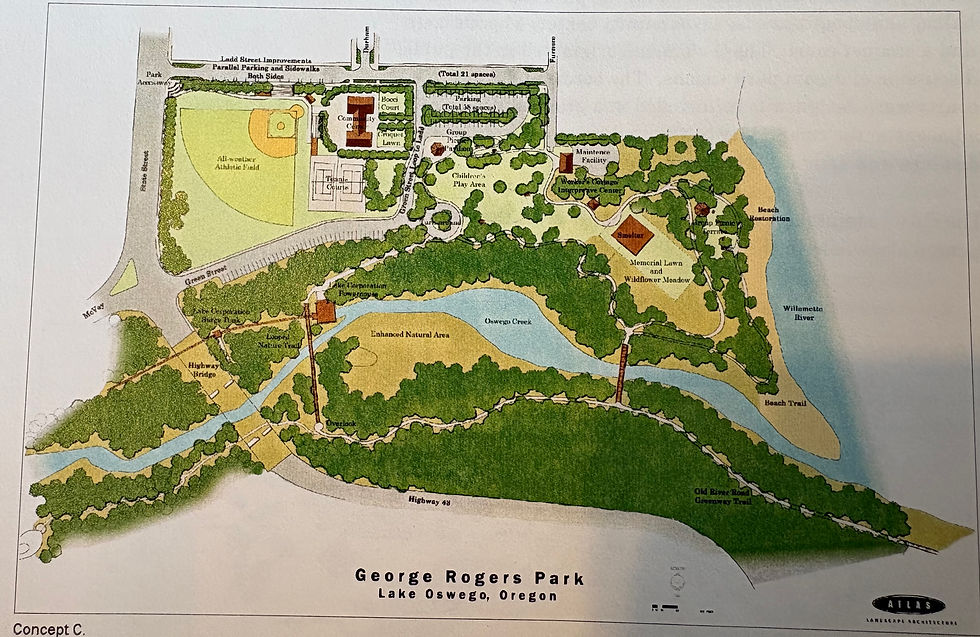
Public response was mixed

The preferred plan was a combination of the best elements of the other plans.

Unfortunately, after this heroic investment of time and money, the plan was "shelved".
Neighbors who live in Old Town now who lived there during this time explained that the City did not have any budget or means to get funding for this grand plan. I'm sure there must be more to the story so I did some online research and learned:
It probably was never “fully funded” because it was designed as a long-term, phased vision—not a committed capital project. The 2002 George Rogers Park Master Plan itself says exactly that: it was intended as a 25-year implementation strategy, with improvements broken into phases “to fit within yearly budget parameters,” not as one bonded or appropriated package.
It may have been adopted as a vision, not Funded as a project. Adoption ≠ appropriation. In Lake Oswego, the plan became a governing framework for later development review, which is why it still has regulatory relevance today.
That apparently means it had legal/planning value even without funding.
Competing capital priorities likely took precedence.
Between 2002 and now, Lake Oswego funded major parks and capital projects elsewhere, including:
Foothills Park riverfront redevelopment
Luscher Farm expansion and master planning
LORAC
Rassekh Park
new recreation and pathway investments
Some pieces of the plan were implemented—but selectively
The City’s current park history notes the lower riverfront area was upgraded in 2005 with river access, landscaping, and habitat restoration. That suggests the plan was not ignored—it was partially cherry-picked. Apparently it is common for cities to fund the easiest, grant-eligible, or politically supported pieces first. The extension of the Willamette River pathway is funded from Metro funding.
The expensive traffic/parking elements of the 2002 Master Plan were not implemented
These are still our biggest current issues—parking, circulation, access management. Apparently they are hard to get support for because they:
can reduce convenience for park users
create neighborhood controversy
sometimes require state coordination (e.g., Oregon Route 43)
don’t produce visible “ribbon-cutting” wins
Playgrounds get funded faster than parking management systems.
Demand changed dramatically from 2002 to 2026
In 2002:
paddleboarding barely existed as a mass activity
social media didn’t amplify destinations
regional recreation patterns were very different
The plan may have underestimated how much GRP would evolve into a regional launch point. That means the problem outgrew the plan before the plan was built.
As the Old Town Neighborhood Association we want to know:
Which recommendations from the 2002 Master Plan remain unimplemented, why were they deferred, and what would they cost today?
And specifically to the Parks & Rec and the Parks Advisory Board:
Can you please provide a matrix of the 2002 Master Plan recommendations showing: completed, partially completed, not completed, and reasons for deferral.
Hopefully all this work can be leveraged by the current City leaders and Parks & Rec staff and the Advisory Board to consider what can be done to maintain and upgrade George Rogers Park to address the problems but also to make it even more of a showcase Park in LO.
Related Articles/Blog Posts:
What George Rogers Park is like now - photos and issues neighbors have raised.
What George Rogers Park is like in the summer of 2026
Can we work together...


Comments