
Bryan Guiney, Candidate for LO City Council Toured Our Old Town Neighborhood with Us

Updated: Sep 7

Bryan spent two hours with us on Saturday September 5th. What impressed us most was how much time he spent listening to us and problem-solving with us.
We walked through the neighborhood, talked about our history and concerns, and discussed both the "big stuff" facing Lake Oswego and "small stuff" problems that are important to our neighborhood.
Bryan asked excellent questions. He took notes.

At the end of our time together, he asked us:
"If I was elected and a year later your neighborhood said we'd made a big difference, what is one thing that you'd say was done that would really make a difference in your neighborhood?"
I said: Create a summer traffic plan for George Rogers Park and Old Town.
He wrote it down. We've been asking for this for three years.
Jim Perris said: Implement a Good Neighbor Policy.
Bryan asked what that meant.
Jim explained that one of OTNA's priorities is to: "Create a 'Good Neighbor Policy' for George Rogers Park and Old Town that recognizes the importance of public access to our parks while also protecting the livability and safety of the surrounding neighborhood."
The idea was suggested to us by Interim City Manager Lynn Peterson as one possible way to address our concern that Old Town effectively becomes the overflow parking lot for George Rogers Park during the summer.
Jim explained that George Rogers is now treated as a regional destination park, even though it was originally designed as a neighborhood park—and that the way the City manages the park has not fully caught up with that change.
Ann Garcia said: Improve pedestrian safety.
Bryan wrote that down too and asked about several of the locations we pointed out during our walk.
Michael Schmidt said: Address people sleeping in vehicles on neighborhood streets.
Bryan told us that Wilsonville has an ordinance addressing this issue and provides a place where people living in vehicles can go. That prompted me to do some research, which I wrote about in this blog post.
Four OTNA Board members. Four different OTNA top priorities shared from our list of 7. And we talked about our other three neighborhood priorities during our walk-about with him. He wrote things down, he asked excellent questions, he offered possible solutions, others he said he wanted to do some research about.
Who is Bryan Guiney?
Of course, meeting someone for two hours doesn't tell you everything about them. But here's what we learned about Bryan:
He has lived in Lake Oswego for five years, in the McVey/Southshore area, and has family who also live here.
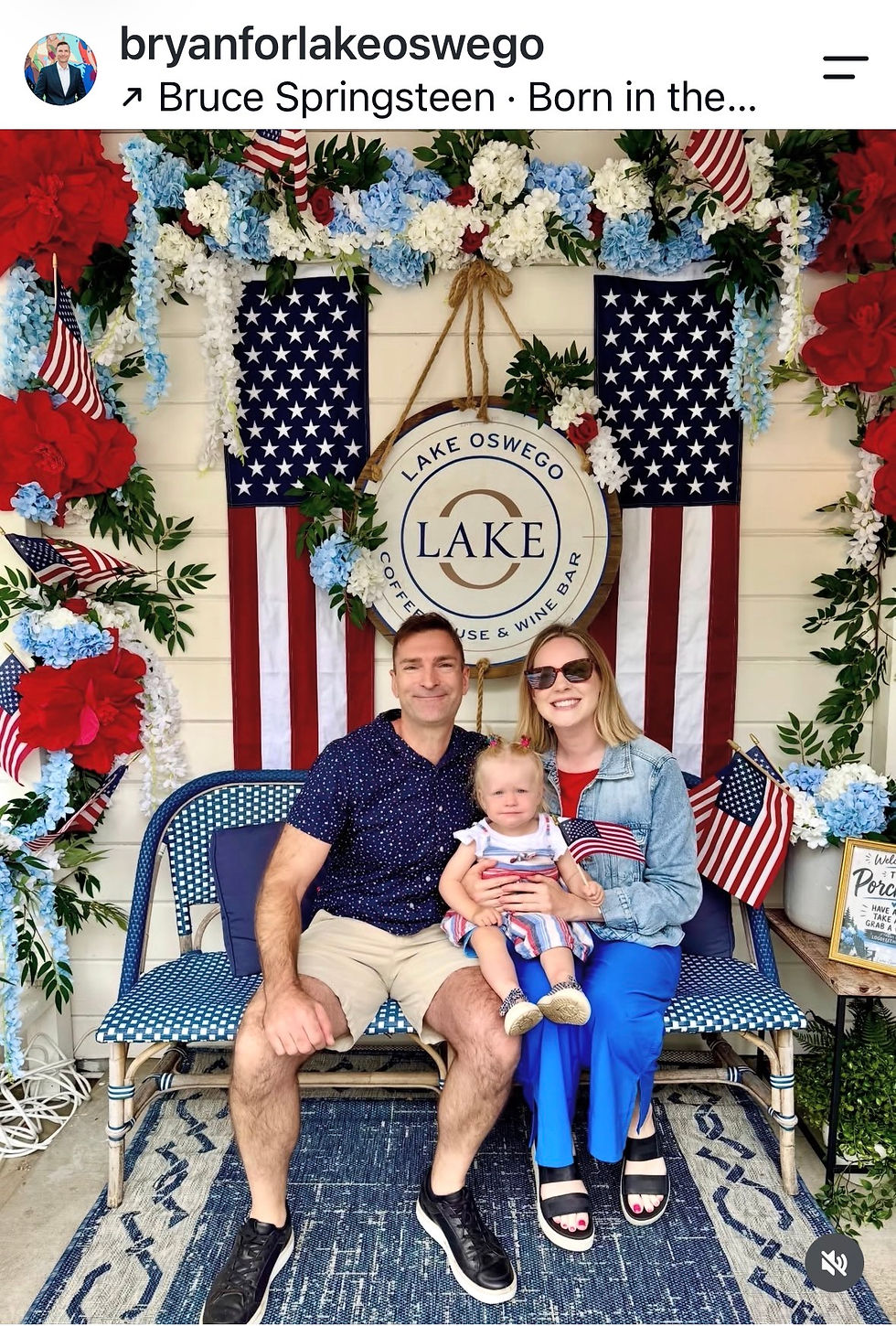
He's a husband and father, married to Christina, with a 20-month-old daughter.
He's a dog dad to 14-year-old Pancakes.

He served for 21 years in the U.S. Marine Corps, including active duty and reserves. He was an infantry officer and mountain warfare instructor and deployed to Iraq before retiring as a Major in 2022. Michael Schmidt said, "With hands-on experience in community restoration in a war zone. He was able to get the cooperation of a variety of players." I thought, "He'll support LOPD and LO Fire."
He's a University of Oregon graduate and earned an MBA from the University of Washington. He told us that "The GI Bill helped me attend the University of Oregon in Eugene, where I met my wife, Christina, and after leaving active duty, I went on to earn my MBA from the University of Washington."
His civilian career has been in public service. He worked in the Oregon Legislature, then at Business Oregon as an economic development officer for Clackamas, Multnomah and Washington counties.
He now works for the U.S. Department of Housing and Urban Development (HUD) as Director of the Oregon Field Office, working at the intersection of housing, economic development, local government and federal investment.
He's had an important volunteer role with LO. "I’ve had the opportunity to give back to our community by volunteering on the Lake Oswego Planning Commission, working through the land-use, housing, tree code, and growth issues that will help shape our city’s future."
A man who drove up in an older car on his Saturday morning and told us he was able to serve on City Council the next 4 years because, "My wife is on board and our daughter is young, before we'll be going to swimming and sports games. I'm good at managing my time and priorities with a cadence."
And perhaps most importantly for a City Council candidate and Council Member: he was easy to reach, easy to schedule, showed up prepared and seemed genuinely interested in learning about our neighborhood.
He also told us several things that really impressed me:
"It's a privilege to be a public servant, not a right."
"My civilian career has also been rooted in public service."
About his current job with the government, "We work for you."
What would Bryan prioritize if elected?
What he showed us: he would get out and meet with, listen to and act on neighborhood concerns. He spent his time asking us questions and listening to learn what WE cared about vs. sharing all of his priorities with us.
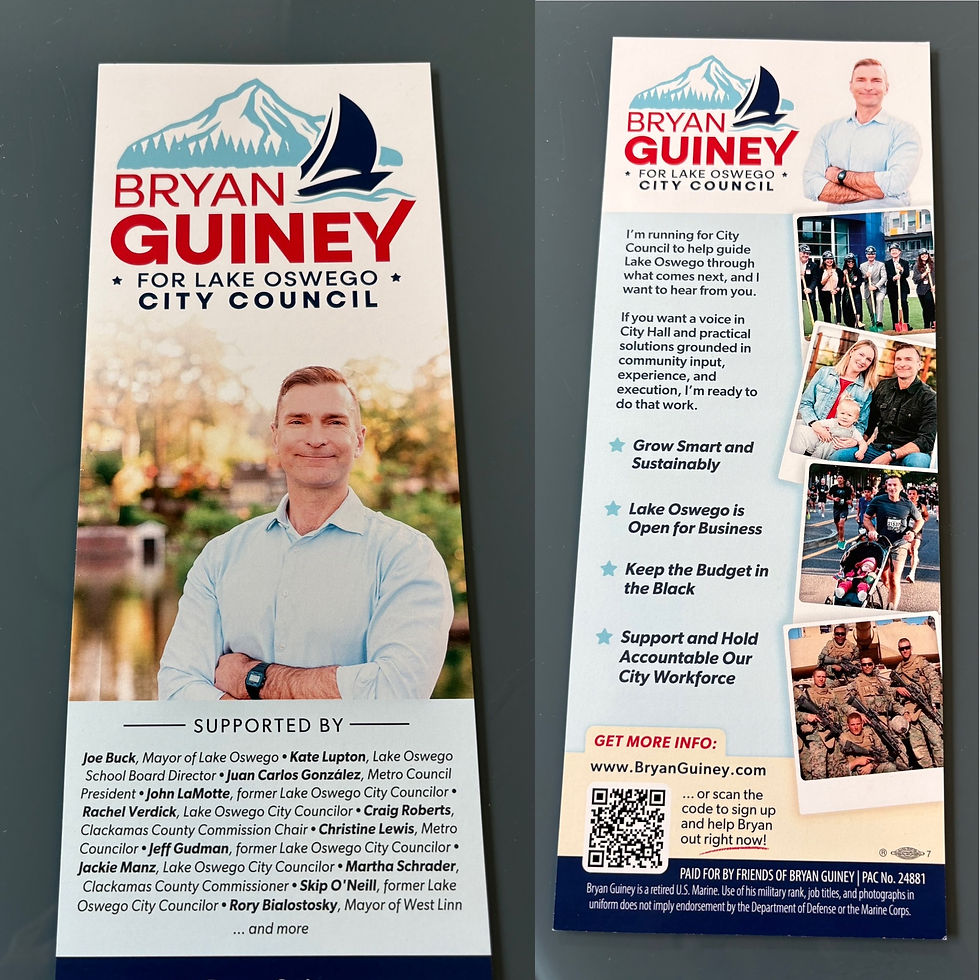
Bryan's campaign website lists four priorities:
Grow Smart and Sustainably
Lake Oswego is Open for Business
Keep the Budget in the Black
Support and Hold Accountable Our City Workforce
His broader statement is about protecting what makes Lake Oswego special while planning responsibly for the future, including directing housing and redevelopment to appropriate locations, strengthening downtown and village centers, improving walkability, supporting local businesses and families, and maintaining disciplined budgeting and long-range planning.
What I found particularly interesting was how those priorities translated into our conversation.
He wasn't there to give us a campaign speech.
He was there to learn about our neighborhood problems and priorities.
What we talked about on our walk through of Old Town
We covered a LOT of ground—literally and figuratively.
George Rogers Park and "shelf plans"
We talked about the 2002 George Rogers Park Master Plan, which ultimately became "shelf ware" because it was never funded and the plan was put on a shelf.
Bryan immediately connected that experience with some of the other major projects the next City Council will be dealing with—including the Foothills District, the library and B Street development. People's volunteer time and City staff time are valuable. Let's use them well. Same with the money.
His reaction was clear: he doesn't like plans that sit on a shelf either.
Pickleball—and what happens when City processes don't work
We talked about the long saga of pickleball at George Rogers Park. Parks & Rec wanted to provide a place for this increasingly popular sport. But the City didn't follow their own processes and guidelines.
There was no neighborhood meeting about this.
The courts were as close as 42 feet from homes when the City's stated guideline was 150-foot guideline. PB is LOUD. Tennis is not.
We explained it took a year of neighborhood advocacy for the City Council to vote to return the courts to tennis. Then a similar issue arose at Westlake.
Residents shouldn't need lawyers, protests or T-shirts to get the City to revisit a decision. We feel sometimes the right answer is simply: "We got this wrong. Let's fix it."

Our expectations of City Councilors? When neighborhood residents raise a legitimate concern, City officials should listen, investigate and respond promptly.
Retaining and recruiting top performers to work at the City
That's important for all City departments, especially our police and fire departments who can't get a "sub" or "contractor" to fill in when the department isn't fully staffed.
We shared with Bryan about several top performers who went "above and beyond" who have left or we don't want to leave. Bryan agreed, ""We need to keep and retain our best City employees."
High Density, Affordable Housing...with no parking
Nobody wants this. Bryan's answer, "Let's grow smart and put high density housing where it makes sense...Tie the City code for high density with public transportation, not in neighborhoods like First Addition."
The wastewater treatment plant
Bryan knows about the project and made an observation that was news to us: "We won't know if it will smell until they turn the switch." Yikes!
LOPD Community Police Officer Cory drove by while we were doing our walk about with Bryan and stopped to talk with us.

Bryan asked Cory what it was like at GRP, "Active. A lot of people come here now. It's a destination park." Cory talked about the increased patrols during the summer and ticketing, "We can see if people got a ticket once and then came back and got another. That doesn't happen. Most people come to the Park once as a destination. It's safe and they can get to the water." Bryan and Cory bonded when I introduced Bryan as an ex Marine and they both smiled nicely at me and explained, "You're always a Marine."
Bryan asked what would help with George Rogers Park?
He asked whether a shuttle bus circulating around Lake Oswego and dropping people at George Rogers Park and the waterfront parks in Foothills might help reduce traffic. Michael pointed out one of the practical problems: people coming to the river often bring strollers, wagons, coolers, paddleboards and lots of other stuff. Would they really carry all of that onto a shuttle?
The shuttle works great for the Arts Festival but people aren't coming with all sorts of things to that event or the Car Show or 4th of July Pancake Breakfast.
Bryan then suggested another possibility: What if people could drop off their gear and then use the shuttle to return to their cars? We weren't sure whether people would actually do that. But we liked the question and that he was thinking about solutions. We know Forest Park had a pilot shuttle service this summer.
Destination Parks also close the parking lot when it's full. And some Parks charge for parking and create permit parking in the adjoining neighborhoods. Lots of pros and cons with that. But also a potential revenue source to make park maintenance and upgrades perhaps self-funding at GRP? Many destination Parks also have proactive traffic management plans for busy season.
People sleeping in vehicles
We talked with Bryan about people parking and sleeping in vehicles on Old Town streets. They can't sleep in any vehicle overnight at George Rogers. But they can on our neighborhood streets. Neighbors have told us these people are aware of the 72-hour rule before police can cite someone. We wondered whether providing people with something like $50 gas cards might help encourage them to move along.
Bryan immediately saw a potential unintended consequence: "Word would get around that LO is giving out gas cards and we'd have a lot of people coming for gas cards."
Then he told us about Wilsonville's approach, where police can direct people sleeping in vehicles to a designated location at the City Hall parking lot. That gave us hope and something new to investigate where we learned more and shared on this blog post.
Pedestrian safety and Ladd Street
We walked down Ladd Street, which gets a tremendous amount of traffic from people heading to George Rogers Park and the river, as well as people attending City events such as the Arts Festival, car show and Fourth of July Pancake Breakfast.
We showed Bryan the problems we see:
drainage issues;
the condition of the street;
heavy pedestrian and vehicle traffic;
and the lack of a safe, clearly defined place for parents to drop off and pick up children attending camps and activities.
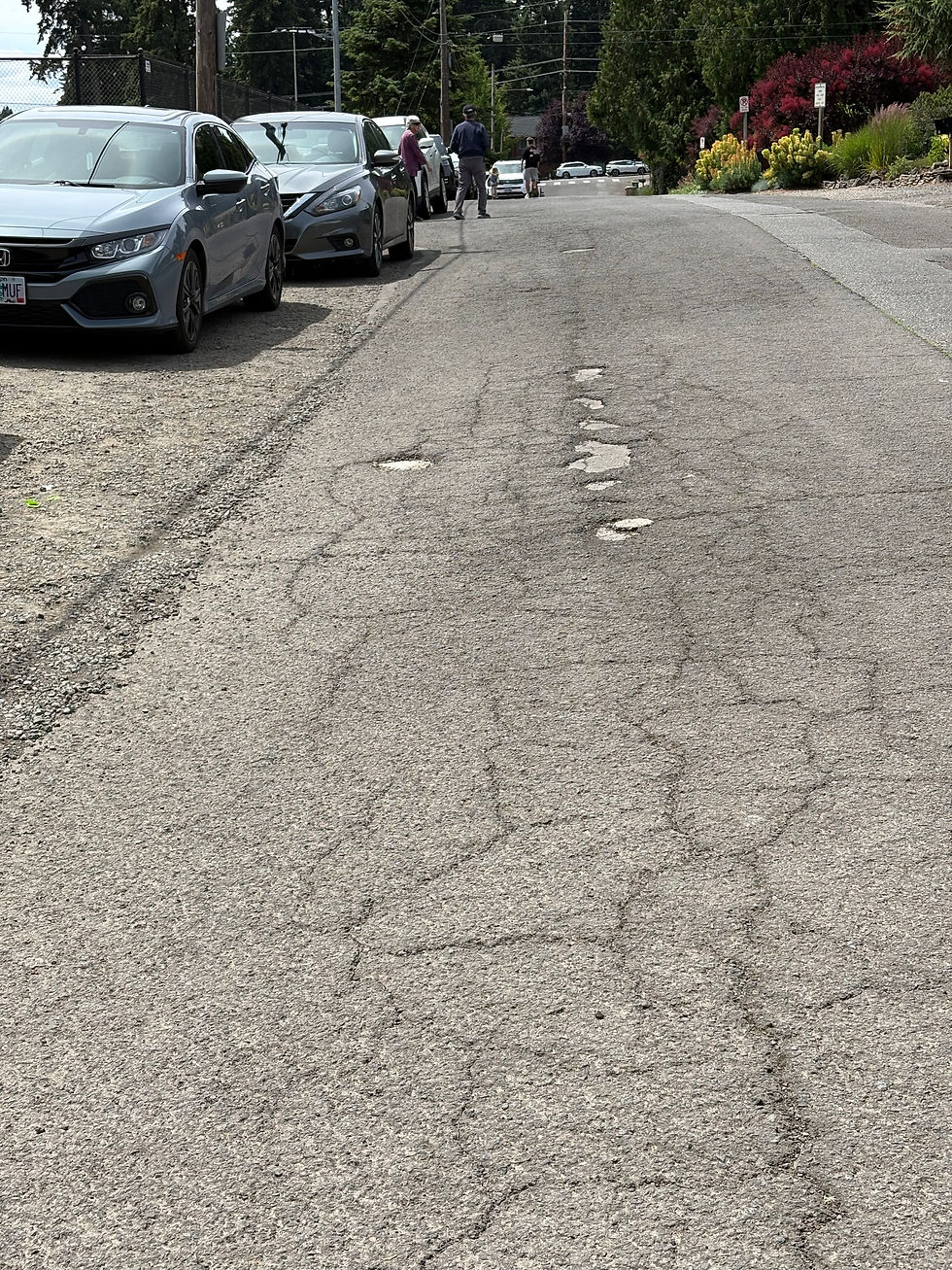
Currently, some drop-offs occur around Ladd and Durham, without the kinds of safety features provided at places such as LORAC. Bryan wrote it all down.

Furnace Street
We also talked about our frustration trying to get what seems like a relatively simple safety improvement: clear no-parking restrictions on Furnace Street between Ladd and Wilbur. Some signs have been added. One area is still problematic.
The street has no sidewalks, carries two-way traffic and is heavily used by people walking and biking to the park. From our perspective, it is a safety problem for people coming and going into the City's Park. We've been asking the City to address it for three years.

We believe the people who are actually out there—neighbors, police and fire personnel—should have an important voice in identifying these kinds of safety problems and recommending possible solutions.
We hope our City Councilors will proactively seek the input of the "eyes and ears" of the people actually out experiencing what happens on weekends and nights.

The "small stuff" matters to neighbors and neighborhoods
And it doesn't come up as topics on the City Council agendas. Who do we go to with concerns and problems? The City Manager seems to be the "customer service" department. And the CC hears a lot of public comments too. There's got to be a better way to use everyone's TIME.
During our conversation, I shared something Interim City Manager Lynn Peterson said at a Neighborhood Chairs meeting. The City has a lot of "big stuff" going on AND
"The small stuff matters too."
"It's important to solve problems in neighborhoods quickly."
That is exactly what we were talking about with Bryan. For two hours, he listened, asked questions, took notes and worked through possible solutions with us. We talked about the "big stuff"—the library, Foothills, B Street, housing, the wastewater treatment plant, the City budget. And we also talked about the "small stuff"—parking signs, pedestrian safety, drainage, park traffic and people sleeping in vehicles.
What did the OTNA Board members think?
After Bryan left, we regrouped and I asked the other Board members to describe their impressions of him. Here are some of the words they used:
"He's awesome!"
"Strong and appropriate experience for the job of a City Councilor. Understands the pluses and minuses of public service. Organized. And a good guy."
"Bryan has many solid qualities and background experiences that would make him a great CC member. He seems very knowledgeable about the big issues that LO is facing and listened intently to our specific neighborhood issues. I am very impressed by him."
"He's impressive in many ways with military, educational, work and volunteer experiences. He really seems dedicated to doing a great job if he was elected."
"He's accessible, approachable, thorough, can-do, curious, friendly, collaborative, follows up, experienced and humble, family-oriented and someone I'd call 'born to serve'. Wow, would we be fortunate if he was elected to our City Council!"
Those are our impressions after spending two hours with him.
Of course, one two-hour meeting doesn't tell us everything we need to know about any candidate. Residents should look at all the candidates, their experience, their positions and their answers to questions before deciding how to vote.
But we think meeting candidates in our neighborhoods is valuable. We get to ask questions. They get to see the problems firsthand.
And perhaps most importantly, they get to hear directly from the people who live here.

Bryan's own words
I asked Bryan to write to me about his experience so I could report it accurately.
Here's what he sent after our meeting:
"Thank you all + Walter for the great meeting today and for answering all of my questions! I have a few pages of notes to dig through!
A little more about me:
I enlisted in the U.S. Marine Corps out of high school and served for 21 years on active duty and in the reserves as an infantry officer and mountain warfare instructor, including a deployment to Iraq, before retiring at the rank of Major in 2022. The GI Bill helped me attend the University of Oregon in Eugene, where I met my wife, Christina, and after leaving active duty, I went on to earn my MBA from the University of Washington.My civilian career has also been rooted in public service. I worked in the Oregon Legislature as committee staff and later at Business Oregon as the state’s economic development officer for Clackamas, Multnomah, and Washington counties, helping Oregon businesses grow, invest, and create jobs. I then joined HUD, where I now serve as Director of the Oregon Field Office, working at the intersection of housing, economic development, local government, and federal investment.For the past five years, my family and I have called Lake Oswego home. I’ve had the opportunity to give back to our community by volunteering on the Lake Oswego Planning Commission, working through the land-use, housing, tree code, and growth issues that will help shape our city’s future.Please reach out anytime! Bryan"
I think that note—and our two hours together—give you a pretty good sense of the person we met. Accessible. Prepared. Curious. Experienced. Practical. Friendly. A good listener. And someone who clearly believes that public service means serving the public. That seems like a pretty good place to start.
Related OTNA Blog Posts:


Comments