
Update on Willamette River Pathway and George Rogers Park from Parks & Rec

Updated: Sep 1

An update from our meeting with Lake Oswego Parks & Recreation
(I asked Bruce and Robin to ensure this blog post was accurate and heard back from both of them today August 31st. I have incorporated their changes.)
On Friday afternoon, August 28, Jim Perris and I met with Bruce Powers, the construction project manager for the Willamette River pathway, and Robin Krakauer, Parks & Recreation's communications lead.
We wanted to meet Bruce as he takes over the role previously held by Kyra Haggart, who has accepted a new position in Tualatin. We loved working with Kyra and will miss her, but we're very pleased to report that we were impressed with Bruce and appreciated the opportunity to learn more about the pathway, George Rogers Park and some of the issues affecting Old Town.
Bruce brings 30 years of construction-management experience to the project. He previously led construction of LORAC, ACC and the new Tennis Center and is now managing the Willamette River pathway project.
According to Bruce, the pathway remains on schedule for completion in October and is on budget. Robin is already working on plans for an opening celebration.


What we learned from Bruce about the pathway
There will be fences on both sides of the pathway
One of the biggest surprises for us was learning that there will be chain-link fencing along both sides of the pathway.
The standard fence will be approximately 6 feet high, although Bruce said some homeowners have requested 5-foot fencing, which will be accommodated.
Homeowners will have gates with locks.

What about access to the river from the pathway?
We also discussed an interesting question: Can someone access a private riverfront property from the water?
We learned that Oregon's laws concerning navigable waterways and the Public Trust Doctrine distinguish between accessing the river from private land and accessing the shoreline from the river.
In general, the public does not have a right to cross private upland property to get to the river. However, Oregon law provides public rights associated with navigable waterways, including recreational use of portions of the river and riverbank.
The important boundary is generally the ordinary high-water mark.
That means the situation is more complicated than simply saying "the shoreline is private" or "the shoreline is public." The exact location of the ordinary high-water mark and the ownership and legal status of each property matter.
For example, someone arriving by kayak or paddleboard from the river may have different rights than someone leaving the public pathway and walking across a private property toward the river.
This is something we'd like to understand better before the pathway opens. It would be helpful for the City to clarify where the public/private boundaries are along the pathway and what rights people arriving from the river have.
E-bikes, bicycles and safety on the pathway
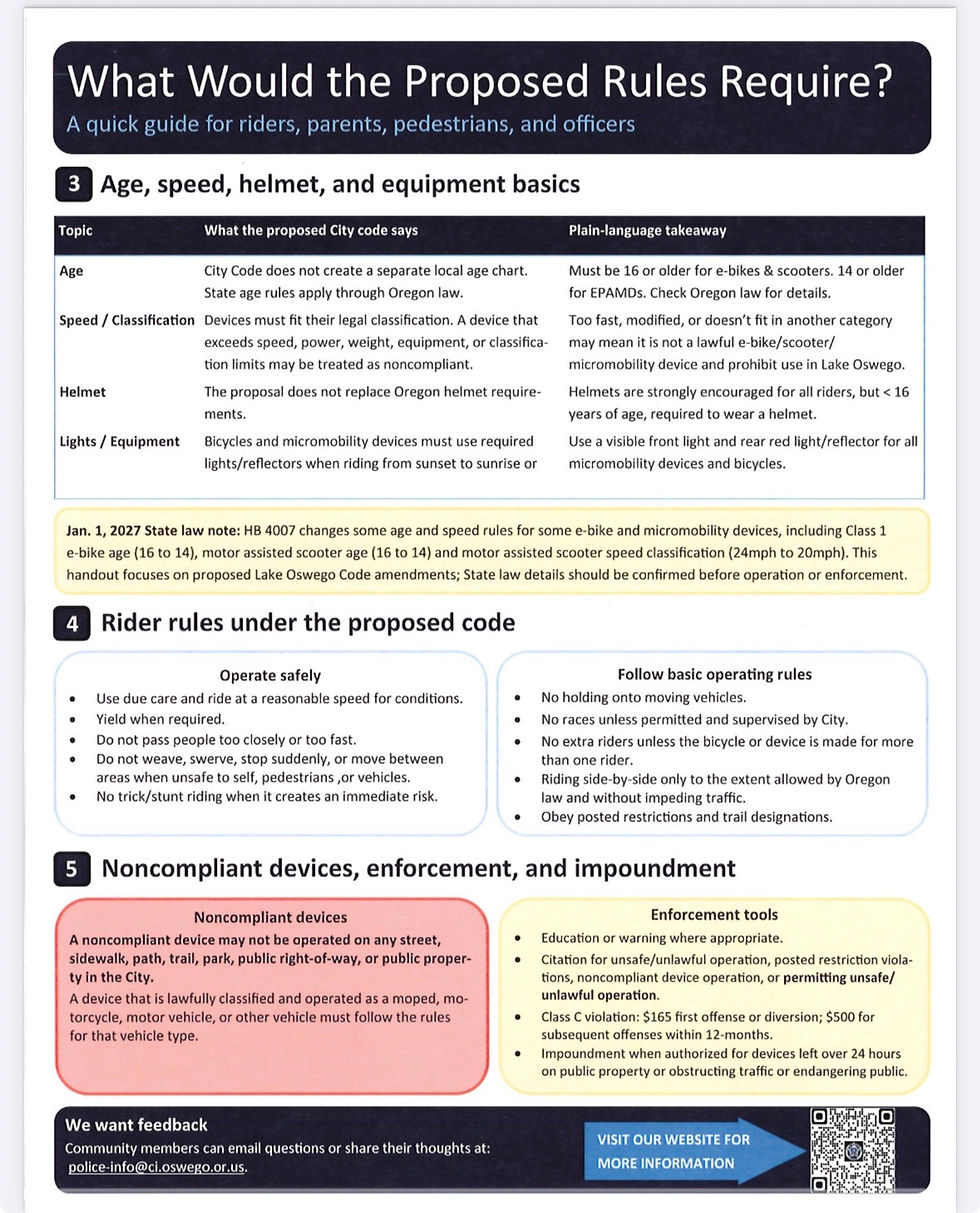
Robin told us Parks & Recreation has been working with LOPD and the CSO team on safety issues, including people riding e-bikes at inappropriate speeds.
Police are working on both enforcement and education. Robin even mentioned that there may be a "sting operation" on the pathway.
Lake Oswego is also working on new e-bike ordinances. These may differ from the rules in West Linn, where some pathway users will be coming from.
Jim Perris summed it up nicely: "It's like state lines."
Robin hopes Oregon eventually adopts more consistent e-bike regulations.
She also believes the zig-zag portion of the pathway leading up to George Rogers Circle will naturally cause people to slow down or get off their bikes.
The pathway has been partially funded by Metro and other grants as a multi-use
path, so it will be shared by e-bikes, bicycles, pedestrians, people with strollers,
walkers with canes, people walking dogs and others.

What do our neighbors think?
Some of our Riverbend neighbors have contacted us asking OTNA to support limiting e-bikes on the pathway.
I asked our OTNA Board member Bruce Glabau, an avid cyclist, for his perspective.
"Multi use trails depend on all participants, walkers, bikers, joggers, and pets. Everyone has to pay attention to other users and be responsible for everyone’s safety. E transportation units that exceed 20 mph are a problem if the riders are irresponsible.
High end standard road bikes can easily exceed 20 mph too given the riders. Restricting use due to a few bad riders harms responsible path users of any type. Also, the class one pedal assist e-bikes are used by less physically capable people to ride which is a good thing. So, after 35 years of commuting on a bike to work, it comes down to responsible path users of all types.
I don’t like e-bikes that exceed 20 mph especially with throttles. Those are motorcycles. As kids we rode gas powered ones but not on paths or sidewalks. Unfortunately, young kids are riding them and many time irresponsibly and unsafely. But, how to reign in teenagers is an age old issue. Hope this helps the discussion. Bruce"
Robin sent this helpful flyer from LOPD about eBikes

There will not be a line on the path indicating right of way
Bruce Powers said that could be done but that was not part of the original plan. That would be a policy decision made by Parks & Rec head Jeff Munro and City leadership.
Path Construction and Drainage
There are currently three people working on the pathway, and Bruce expects paving to begin soon.
He also explained that there will be drainage on both sides of the pathway to reduce or prevent water from accumulating on the path.
Bruce asked us to contact him if we see pathway construction workers parking in the neighborhood. He said workers are not supposed to park in our neighborhood.
After talking about the pathway, we spent considerable time discussing George Rogers Park and the issues that affect Old Town residents
Park maintenance: Where does the money come from?
We asked about funding for park maintenance and learned that Parks & Recreation is currently short-staffed.
Robin explained that the department receives hundreds of applications, but hiring can take two to three months.
That means our Parks staff are stretched thin, with Rick and Josh covering GRP as well as other parks. Let's remember to thank them.
Sometimes it helps to think about this the same way you would at a restaurant when a waitress says, "I'm the only one here tonight covering all these tables."
The work still needs to get done—but there simply aren't enough people to do everything at once.

How does the City pay for improvements to an aging park?
We asked how funding works when an older park like George Rogers needs repairs and upgrades. Bruce put it this way: "Parks are like us, they're getting old and some things need to be replaced. The challenge is finding the money."
He explained that there is a distinction between funding new projects, often through bonds, and paying for ongoing maintenance and upgrades, which generally comes from the City's General Fund.
Bruce and Robin were also very clear about their roles: "We implement. We don't set policy."
Parks & Recreation staff can explain the needs, costs and options, but policy priorities and funding decisions are made by Jeff Munro, City leadership and Council.
They encouraged residents who have priorities for George Rogers Park to attend the monthly Parks & Recreation Advisory Board meetings and make public comments.
One immediate update
Robin said that the Arts Council of Lake Oswego is responsible for the removal of the art piece. Timing of that is to be determined by the Arts Council.

What about Roehr Park and paddleboarding?
We asked about the City's plans to promote Roehr Park for paddleboarding and potentially move Alder Creek rentals there next summer.

We learned several interesting things:
Roehr Park is considered as safe access for the public.
At George Rogers Park, people can wade into the water. At Roehr, paddleboarders and kayakers need to launch from the dock.
We also learned that making alterations for river access at Roehr involves state and federal interests, so expanding water access there would require those governments to be involved.
The Alder Creek rental contract is for three years and is currently in its second year. Unless the City changes its policy, the contract will automatically renew.
We asked Robin to obtain data from Alder Creek showing how many people use the rentals at GRP and where those customers are coming from. That information could be very useful as the City considers how much use GRP is actually receiving from residents versus visitors.
Robin said paving and signage will be added in the next few weeks to make it clearer where people should park and how to access Roehr Park with green striped lines.
Read our earlier post about Roehr Park and paddleboarding https://www.oldtownlakeoswego.org/post/best-paddle-board-launch-in-lake-oswego-why-locals-choose-roehr-park
Picnic shelter rentals and summer crowds
We asked about limiting rentals of the George Rogers Park picnic shelter from Friday afternoons through Sunday during the summer, when the park is particularly busy and Old Town becomes an overflow parking area. Again, this would be a policy decision, not something Parks & Recreation staff can simply implement.

We also learned that picnic shelter rentals are revenue-generating for the Parks & Recreation Department, unlike some other City services. Currently, the rental price is the same for Lake Oswego residents and non-residents. We asked whether that could be changed. Again, that would require a policy decision.
One thing we've noticed is that some of the largest gatherings at GRP are businesses hosting employee events. Some groups bring food trucks and can have 100 or more people arriving by car. And many of these events occur on Friday afternoons—exactly when GRP is already becoming very busy. The result is predictable: when GRP parking fills, our neighborhood becomes the overflow parking lot.
Large groups, noise and illegal parking
We also discussed people arriving with large groups and using the "free area" across from the picnic shelter, sometimes with loud music and numerous illegally parked vehicles.


Parks Rangers and the CSO/Police team are aware of the problem and do issue tickets.
We asked whether some of these activities could be limited. Again, that is a policy question for City leadership.
We may want to explore whether the City already has appropriate noise regulations for parks or whether additional rules should be considered.
Furnace Street parking and safety
We also talked about the improvement in safety resulting from City Engineering installing No Parking signs on most of both sides of Furnace Street between Ladd and Wilbur. This is important because Furnace Street has no sidewalks. It is used by cars traveling in both directions, as well as people walking dogs, children, strollers, wagons, paddleboards and bicycles—all accessing George Rogers Park.
We're still working with the City on one confusing area where park visitors don't realize they should park on the dirt portion beside the road and instead park partially or completely in the roadway.

LOPD and the CSO team have been very responsive about coming out to ticket vehicles that are parked into the roadway. But ticketing doesn't completely solve the safety problem when illegally parked vehicles create a pinch point for cars, pedestrians and cyclists.
We've asked whether the City could use the temporary No Parking sandwich boards that Public Works already puts out during events in this area year-round—or consider parking restricted to residents. That's something we'll need to work with Public Works and City Engineering about.
How many people are actually using George Rogers Park?
This is something we're particularly interested in finding out.
Robin explained that she and Kyra created a Placer AI perimeter around George Rogers Park. Once Robin has finished with the summer events, she can look into providing information showing:
How many people are using the park
Where they're coming from
Which days are busiest
What times of day are busiest
This would be much better than relying solely on anecdotes.
Our observation is that GRP becomes extremely busy in May and June, with significant overflow parking in Old Town, and then appears to calm down somewhat by August.
Now we'll have an opportunity to see what the actual data tells us.
Robin sent this helpful follow-up note after our meeting:
I also wanted to follow up regarding the Alder Creek usage information. I learned that, under our agreement with Alder Creek, we are not permitted to share their proprietary business information with third parties. We are happy to provide some general information regarding the number of rentals this summer; however, Alder Creek does not collect information about where renters are coming from, and we are unable to share revenue or other financial information.
I think the broader and more useful picture will come from our Placer.ai data, which can help us better understand overall visitation patterns and trends at George Rogers Park. That information should provide more meaningful insight into park usage beyond any one individual operator or activity. I hope to get that information sometime in October as I have a variety of other events and conferences to prepare for beginning in September.
Should George Rogers Park have paid parking?
We also discussed whether the City should investigate paid parking at GRP, perhaps using an app such as Parking Kitty, along with some form of neighborhood parking permits.
One potential advantage of paid parking is that the revenue could help offset the cost of maintaining and improving the park.
Neighborhood permits could potentially help prevent Old Town from becoming the overflow parking lot for GRP.
But there are challenges.
Robin and Bruce explained that paid parking and neighborhood permits would require additional staffing and would be a policy decision.
Jim asked whether the City has done a cost-benefit analysis comparing the potential revenue with the cost of administering and enforcing the program.
That's a question worth asking.
We've also previously heard concerns from LOPD about residential parking permits. Chief Dale Jorgensen once explained to me that permits could create enforcement problems when residents have visiting family members or friends who don't have permits.
So there are no easy answers—but it's worth examining the options.
Funding George Rogers Park and LORAC
We also talked about funding for improvements at both George Rogers Park and LORAC.
We'd learned from Tony at another meeting that the estimated revenue that Parks uses for Park maintenance came in significantly lower than expected. So there was a delay in working on the GRP tennis courts and they were repaired vs. resurfaced. Tony Garcia is working on that area.
Jeff Munro had shared with me at another meeting that some other cities have used parks bonds to fund maintenance and upgrades. But Lake Oswego residents have made it clear that they're not particularly interested in taking on additional bonds right now—and the City is also considering the future of the library, which could potentially require significant funding.
Bruce explained that for LORAC, the City owns the entire facility, the LOSD contributes funds annually for maintenance.
He gave us a great example of the difficult choices Parks & Recreation has to make: "When the AC goes down at the tennis center, more people need that than a new picnic shelter by the tennis courts at GRP."
That's the reality of managing a large parks system with limited resources.
A productive meeting - thanks Bruce and Robin!
This was a great meeting and a great opportunity for information sharing and collaboration. We learned a lot about the Willamette River pathway, George Rogers Park, park maintenance, funding, parking, safety and the challenges facing Parks & Recreation. Most importantly, we learned more about who makes decisions and where residents can have an impact.
Bruce and Robin were straightforward with their answers and willing to listen to our concerns. Thank you, Bruce and Robin!
As the pathway gets closer to opening, we'll continue to share what we learn—and what questions still need answers.
Robin shared this helpful information from the City from a prior meeting:
"Study and Improve Parking and Circulation in George Rogers Park ($$$)
Lead Department: Parks & Recreation Department
This longer-term strategy would require hiring a consultant team to assess the existing vehicle parking layout, internal park vehicle and pedestrian circulation, and vehicle, bicycle, and pedestrian access points surrounding the park. The study could inform a set of recommendations for physical improvements to the park to add or reconfigure parking, improve traffic and circulation, reduce conflicts between walkers, bikers, and cars, and better accommodate seasonal traffic surges. The analysis process would likely also involve engagement with neighbors and regular park users to understand their experiences, concerns, and ideas.
Based on the results and recommendations of the study, physical improvements could be made to George Rogers Park to enhance traffic flow, improve access points from surrounding neighborhood streets, and reduce conflicts between vehicles, pedestrians, and cyclists within the park. The study is recommended as a longer-term strategy due to the cost of engaging a consultant team and staff capacity for overseeing the project. Depending on the nature of the improvements that are recommended, the physical improvements will likely require a significant amount of funding to complete. This would also likely be considered a capital project that would need to be prioritized for funding by the Parks, Recreation, and Natural Resources Advisory Board and City Council."
She also shared policy from prior City Manager Martha Bennett and Parks & Rec
Neighborhood Parking Permit System or Dedicated Resident Parking
Parking permit programs require a significant amount of staff time to manage, and the City currently lacks adequate Engineering and Police staff that would be needed to develop this program and manage and enforce it over the long run.
Temporary No-Parking Signs for Residents
The City’s Engineering Department does not recommend providing temporary no-parking signs for residents to place in front of their properties.
Reducing or Eliminating Parks & Recreation Programming during Peak Use Times
During the August 2025 walking tour debrief, neighbors asked the Parks & Recreation Department to limit the number of programs offered at George Rogers Park during peak use times (summer weekends and Friday evenings). Parks & Recreation offers two types of programs at George Rogers Park during the summer: outdoor programs and sports programs.
Outdoor programs and most youth sports camps are held on weekdays only and are either full- day programs from 9:00 a.m. and 4:00 p.m. or half-day camps from 9:00 a.m. to 1:00 p.m.; these programs already do not run during peak use times. The City’s Adult Softball program is also held at George Rogers Park on weekdays in the evenings, and while this program may conflict with Friday evening park visitors, it has to be held in the evenings to accommodate participant work schedules.
Sports program tournaments do typically occur on weekends during the summer months and may overlap with peak use times; however, it is not feasible to move these activities to another park because George Rogers Park is one of only four City parks with athletic fields to accommodate Parks & Recreation sports programs and one of only two with natural grass athletic fields.
While Alder Creek Kayak Rentals also operates on the weekends during the
summer Parks & Recreation does not recommend eliminating this program as it has been a successful partnership that is consistent with the Department’s mission to provide a variety of recreation options to the community."
In Old Town, we hope that these policies can be reviewed with the new City Council and City Manager to encourage more of a "Good Neighbor" approach.
We feel sometimes like George Rogers Park is a AirBnB that hosts large, loud parties. Those type of AirBnbs aren't allowed in neighborhoods. Why are they in our Parks?
Contact information for:
Bruce Powers bpowers@ci.oswego.or.us
Phone: 503-697-6575
Robin Krakauer rkrakauer@ci.oswego.or.us
Phone: 503-534-5422
Parks & Rec Department Leadership
Jeff Munro – Director of Parks & Recreation
Phone: 503-534-5683
Email: jmunro@lakeoswego.city
Jan Wirtz – Deputy Director of Recreation & Adult Services
Phone: 503-675-2546
Email: jwirtz@lakeoswego.city
Antonio (Tony) Garcia – Deputy Director of Parks
Phone: 503-534-5276
Email: agarcia@lakeoswego.city
Anthony Markey – Lake Oswego Recreation & Aquatics Center (LORAC) Superintendent
Phone: 503-534-5203
Email: amarkey@lakeoswego.city
Related articles: Blog Posts About George Rogers Park


Comments