
Emergency Preparedness: What We Learned from Lake Oswego Fire and PrepLO

Updated: 1 day ago
What would you do if your house flooded, the power went out for a week, or a wildfire forced you to evacuate?
At our recent Old Town Neighborhood Association meeting, Chris Rushing of PrepLO and Battalion Chief Scott Vachter of the Lake Oswego Fire Department shared practical advice about preparing for emergencies.
They reminded us that emergencies can take many forms: a flooded home, a wildfire in our neighborhood (Chief Vachter put it, “We live in a forest with a city in the middle of it in LO”), or an extended power outage that leaves us without internet or heat for days. We could also experience an earthquake or tsunami. Are you ready?
Their message was simple: Prepare before an emergency happens. You may need to take care of yourself and your family for days before help arrives.
Here are some of the most important things we learned.
Prepare your household
Have food and water for at least two weeks.
Keep printed emergency information, maps and evacuation routes.
Plan for medications, medical equipment, children and pets.
Know how to shut off your water.
Know when and how to evacuate
Know your evacuation routes and alternatives.
Be ready to leave early, particularly during a wildfire.
Have a primary plan, an alternate plan and contingencies.
Look out for your neighbors
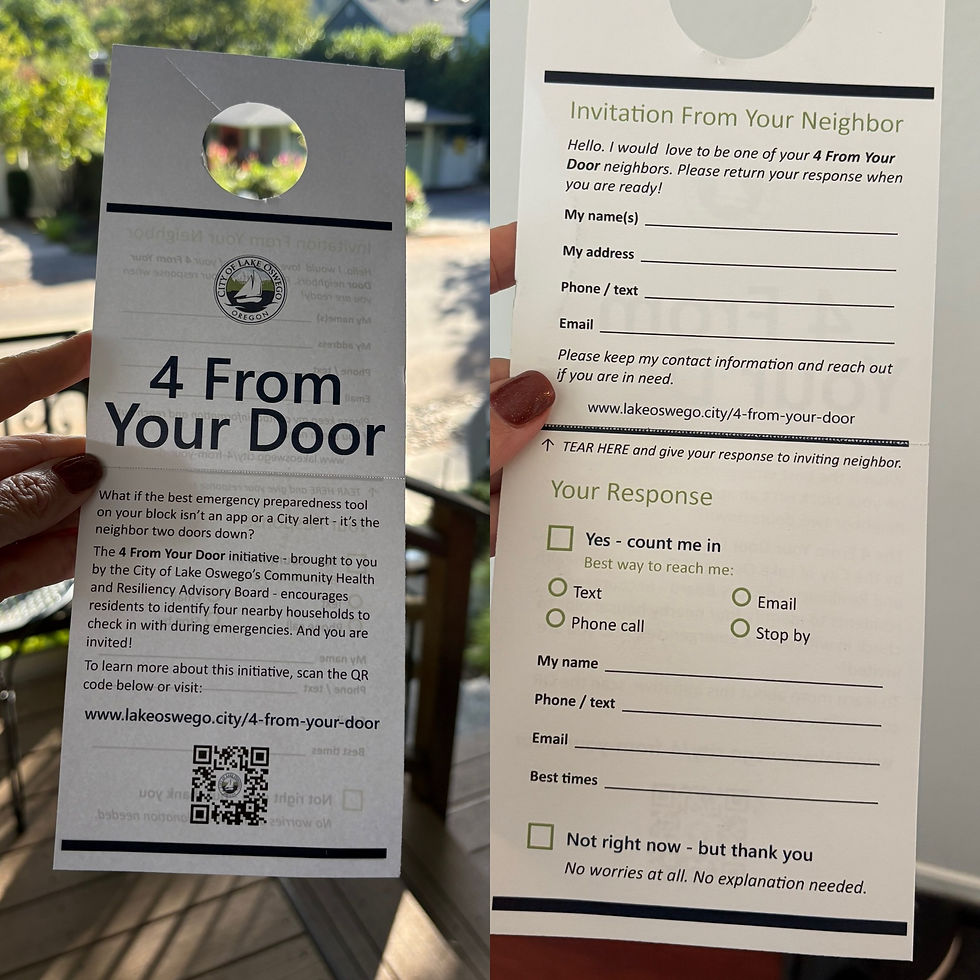
Participate in the “4 From Your Door” program.
Know who might need help evacuating or preparing.
Learn how the neighborhood's emergency radio program will work.
Understand what to do during an emergency
Know how to respond to water, gas and electrical hazards.
Understand local emergency alerts and evacuation instructions.
Learn about the Fire Department's response and CERT training.

What This Means for Old Town
Emergency radios: The City grant secured through Michael Schmidt's application will help fund FRS/GMRS radios for Old Town. Michael and Phil Rossi will work on introducing the program to neighbors.
Know your neighbors: OTNA will distribute “4 From Your Door” hangers to help residents connect with nearby households.
Water and gas shutoff tools: these two tools need to be accessible and you need to learn how to use them.

Tools to turn off the gas and turn off the water Food and water storage: a large water container may supply only one person for three days. The challenges for condo residents and people with limited storage space also introduce an important neighborhood-level consideration: how can neighbors help one another?
Four of the six city council candidates were in attendance to learn with us: Bryan Guiney, Suzanne Miles, Heather Ramsey and Peren Tiemann.
Chris Rushing: Be Two Weeks Ready
If you haven’t explored PrepLO.org, take a look!

Chris Rushing is a volunteer leader of PrepLO. His professional background includes service as a Marine, followed by work with the Department of Defense and the Oregon Health Authority. He shares his expertise with the Lake Oswego community because he lives here and wants to give back.
Chris took the baton from Jan Castle and others who started PrepLO about 11 years ago. The organization is entirely volunteer-run and encourages residents to be “two weeks ready.”
PrepLO has expanded its work to include helping neighbors with special needs, including people living in assisted living centers.
Here’s what we learned from Chris:
Take a “Be 2 Weeks Ready” class. These three-hour classes help residents prepare to care for themselves and assist others during emergencies. They are offered through Lake Oswego Parks & Recreation in December, March, and June. Search “Prepare” at LOParks.org.
Ask your utility provider about medical needs during power outages. Chris encouraged people who rely on electricity for medical equipment, including electric wheelchairs, to contact their utility provider and ask about available assistance or priority programs during extended outages. He specifically recommended calling PGE to learn more.
Take care of your household first. As Chris explained, “In a disaster, fix the disaster at your home first. My wife wants to feel safe, and then I can go out and help others.”
Keep printed information on hand (the Internet will probably be out). In an emergency, we may not have access to Google, AI, or even working cell phones. A printed copy of the Be 2 Weeks Ready booklet, along with maps and evacuation routes, can be invaluable.
Learn CPR. CPR training is an important skill to have in an emergency. Consider taking a class if you haven’t already.
Consider CERT training. Community Emergency Response Team (CERT) training teaches residents skills to help themselves, their families, and their neighborhoods during disasters. Training includes responding to small fires, search and rescue, and disaster medicine and psychology. Learn more at the Lake Oswego Fire Department’s CERT page.
Battalion Chief Scott Vachter: Plan for the Unexpected

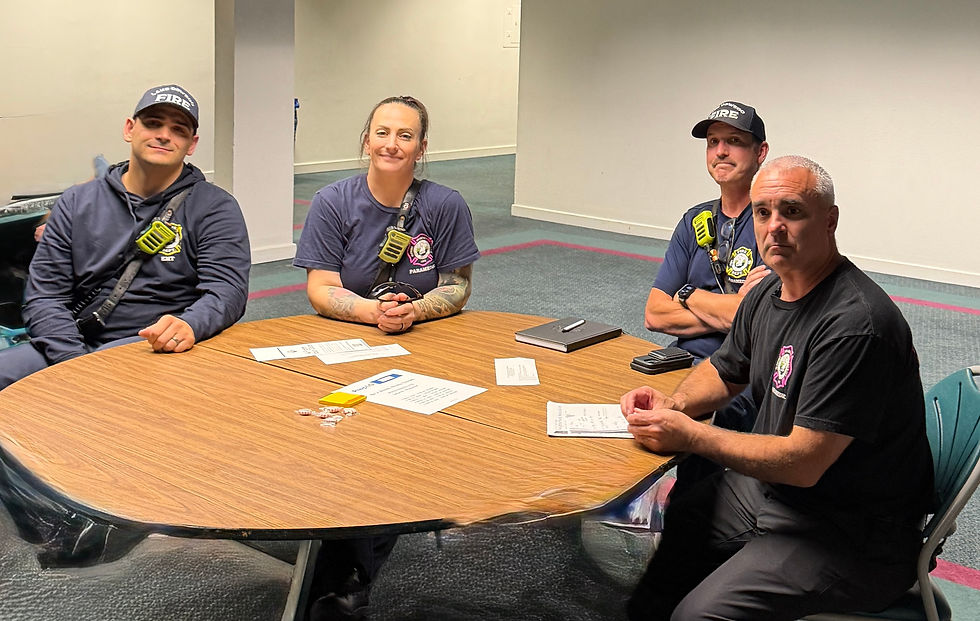
Chief Vachter commanded the room like a football coach, with a small piece of paper holding his notes. He shared lessons from his 30 years as a first responder.
Scott emphasized the often-overlooked psychological effects of emergencies.
He described what it was like when his family and two cats were without power for 10 days in Woodburn, where they live. When the power goes out, it can be dark and cold by late afternoon. When that continues for days, it takes a toll on everyone—including pets.
Teenagers want their phones. People may be reluctant to leave home for a hotel if it means leaving their pets behind. Everyone may be tired, uncomfortable, and eager for normal life to return.
Scott’s experience reinforced an important lesson:
Emergency preparedness means thinking about how people will react, not just what supplies they will need.
Our pets are often an important source of comfort, and during a disaster we must also care for them. Plan ahead for food and water for both people and animals.
As Scott reminded us, “A disaster is different to each of us.” Some people may become so frightened that they freeze and need help moving out of danger.
His advice?
“Plan for the unexpected. And expect the unexpected. You can’t plan for everything.”
What Scott Advised
Leave before you have to. Prepare ahead of time, especially when wildfire threatens. Don’t wait until you're asked to evacuate. Go early.
Know your evacuation routes—and have alternatives. Roads may become congested or unavailable. Scott explained that emergency responders may change traffic patterns, including making some two-way roads one-way, to help people evacuate.
Sign up for “4 From Your Door.” This initiative encourages neighbors to share contact information and look out for one another during emergencies.
Make your status known when it is safe to do so. Scott discussed using an “OK” sign in a window to help responders assess neighborhoods following a major emergency.

Know how to shut off your water, gas and electricity. Learn where your water and gas shutoffs are and keep the appropriate tool accessible.
Understand gas safety. Follow instructions from your gas utility and fire officials. If you smell gas, leave the area immediately and call for help from a safe location. Never turn the gas back on yourself after shutting it off; contact the gas utility for guidance.
Consider communication options. Scott described Starlink as a useful option in areas without cellular coverage and explained that he uses it when fighting wildfires. Learn more at Starlink.
Use safe alternatives for warmth. Layer clothing to stay warm, and never bring a patio heater or propane camping stove indoors. These devices can produce deadly carbon monoxide.
Have a “PACE” plan. Think through a primary plan, an alternate plan, a contingency plan, and an emergency plan.
How Lake Oswego’s Fire Department Responds

The Lake Oswego Fire Department has developed a citywide FRS/GMRS radio channel plan to help residents communicate with their neighbors. The plan divides the city into quadrants.
Our neighbor Phil Rossi is knowledgeable about the program. Thanks to Michael’s grant application—and guidance from Dennis and Laura, who lead the Evergreen Neighborhood Association—Old Town has received City funding to purchase radios. Michael and Phil will work together to roll out the program in our neighborhood.
Chief Vachter also explained what the Fire Department does during an emergency:
Survey the station and assess conditions.
Check communications among stations.
Drive through the area to identify hazards, establish priorities, and develop a response plan.
Adjust the plan and priorities as new hazards emerge.
Coordinate with neighboring fire departments and other agencies.
Scott explained that fire stations maintain their own response zones so that emergency teams and equipment aren’t all moved into one area, leaving other areas without adequate coverage. That makes the South Shore Fire Station particularly important to our neighborhood. Its continued role in the City’s emergency response system matters to Old Town residents.
Scott also recommended our earlier blog post, “14 Simple Things We Learned at Lake Oswego’s Emergency Preparedness Fair”, which offers additional practical steps we can take to prepare.
Three Things You Can Do This Week
Visit PrepLO.org and learn about the “Be 2 Weeks Ready” program.
Find your water shutoff and learn how to use it. Review your gas utility’s safety instructions, too.
Connect with four nearby households and discuss how you can check on one another during an emergency.
Then consider what your household would need if you had no electricity, internet, or easy access to supplies for several days.
Emergency preparedness isn’t just about supplies. It’s about knowing what to do, making a plan, and building relationships with the people around us.


Comments