
What I Learned About Hydrangeas from Joe at 7 Dees

Updated: Aug 19

Our hydrangeas are like our pets—they get a lot of TLC, and in return they bring us a lot of joy.
Over the years, and across the three homes I’ve owned in Lake Oswego, hydrangeas have always been part of my garden. And whenever I’ve needed advice, I’ve gone to Joe at 7 Dees in Lake Oswego.

Last weekend my husband Michael and I attended a formal hydrangea talk Joe gave. Joe definitely knows hydrangeas!
Know What Type of Hydrangea You Have
There are many different types of hydrangeas, and knowing which variety you have makes all the difference when it comes to pruning, feeding, and helping them thrive.
Joe handed out a very helpful guide explaining the different types that I took photos of and added to the end of this blog post.
Out of curiosity, I uploaded a photo of our hydrangeas into ChatGPT and asked what kind they were. I learned ours are bigleaf mophead hydrangeas—the classic round-flowered variety so common here in the Pacific Northwest.

Soil Determines the Color
With bigleaf hydrangeas the soil affects their color.
More acidic soil = bluer blooms
Less acidic soil = pink blooms
Joe advised me to use hydrangea blue soil acidifier a few times a year to intensify the blue color. While the packaging recommends monthly applications, Joe—and several master gardeners I trust—say that isn’t necessary.
The best timing:
October
Early February or March
June
And the key is to apply it around the drip line, not right at the base of the plant and to water it in.
“The Soil Matters Most”
That’s something Joe has taught me for years. Every winter, we put a bag of organic compost around each hydrangea, and then add more in the spring. And we don't use the "blow and go guys" anymore because they just blew the good dirt away. We now leave the leaves in the winter and then take them up in the spring.
One important lesson we've learned: know where the drip lines are and avoid burying them too deeply or covering them with compost.
Our DIY Hydrangea “Moats”

Years ago I created what I call hydrangea moats around each plant. Because many of ours are planted on a slope, I used wide brown plastic edging and stakes to create circular basins around them, then filled those areas with compost. It has made a huge difference in helping the plants retain water during hot summers.
Another smart suggestion came from my master gardener friend Kristine: adding two fully open drip irrigation emitters to each hydrangea plant.
Hydrangeas Need More Water Than You Think
Joe emphasized this several times in his talk: hydrangeas need a lot of water.
His suggestions:
Run irrigation as early as 5 a.m.
On hot days, hand-water at the base of each plant in the late afternoon
You can also run irrigation around 6–7 p.m., once the sun is off the plants
He also shared that hydrangeas can absorb water through their leaves. My master gardener friend Peggy says: "Hydrangeas love a little spritz when they look wilted from the hot sun." Joe agreed—but cautioned against watering in direct sun, since that can burn the leaves. As he put it: "A shower can take the heat down on a 90-degree day."
One of the best tips Joe gave was placing two tuna cans near each plant while irrigation is running to help measure how much water the plant is actually getting. He also reminded us to check for and remove leaves or debris blocking drip emitters.
Feeding Hydrangeas
Joe recommends feeding hydrangeas with:
Portland Rose Fertilizer
E.B. Stone Organics Rhody, Azalea & Camellia Food
Best feeding times:
October
Early February or March
June
His advice was not to fertilize later in summer. Why? "Because you want the plant to start preparing for winter and thicken up rather than push out tender new growth."
He also recommends adding magnesium (Epsom salts).
Joe shared about fertilizer sold at big-box stores: "That’s like giving your plant a shot of espresso instead of a sustained meal."

Clean Up Matters
Joe stressed the importance of removing damaged or unhealthy leaves—especially near the base of the plant. This helps direct more energy and water to healthy growth.
You can also cut leggy blooms for flower arrangements. But for our variety, major pruning should wait until fall or early spring.
Our “Hydrangea Hats”
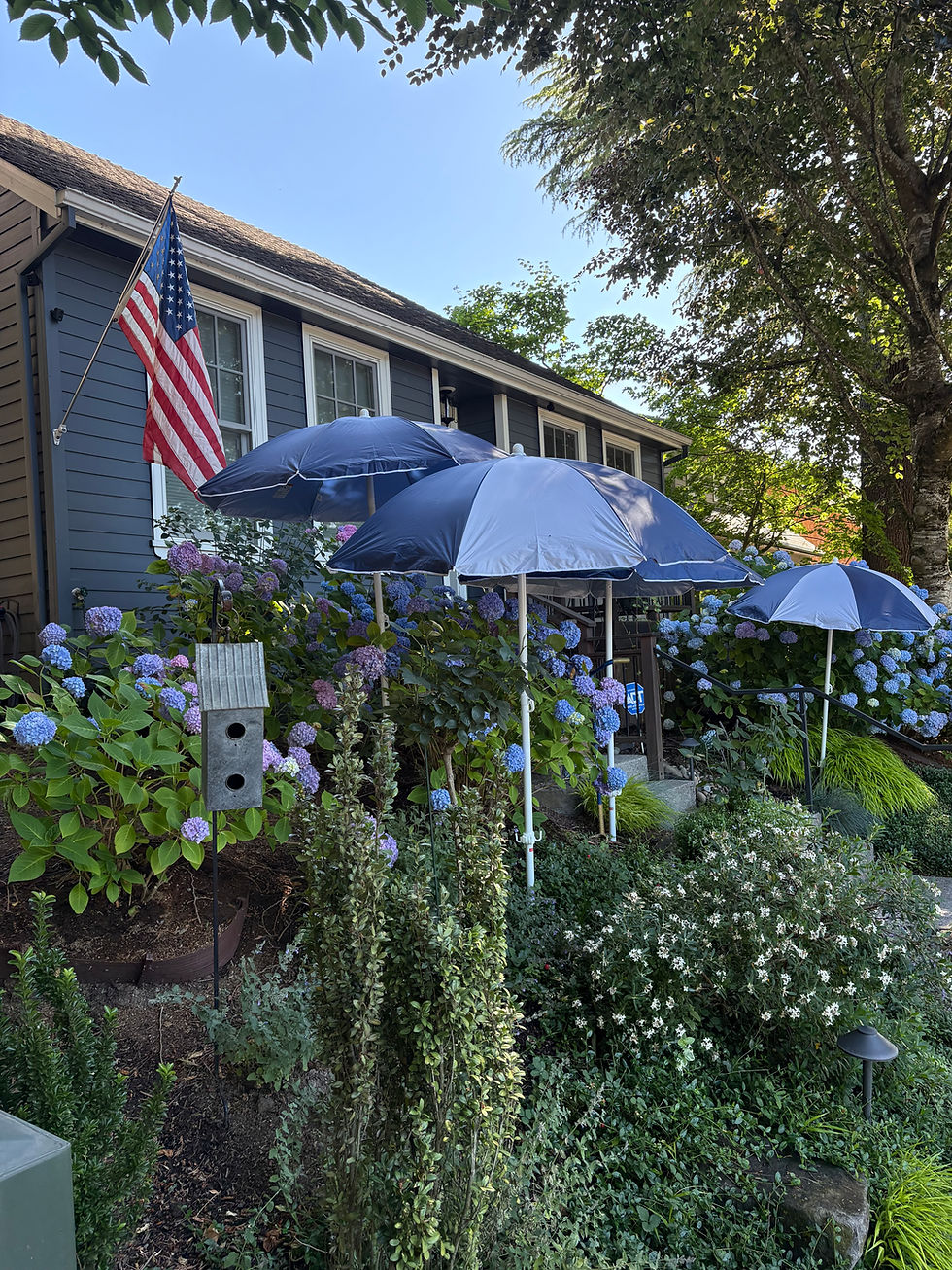
On especially hot days, we put what we call hydrangea hats on the plants that get the strongest afternoon sun. They’re actually beach umbrellas I found on sale at CVS.
They’re designed to screw into sand, which works surprisingly well in the garden too.
Joe said cheesecloth can also work for temporary shade, but we had a hard time securing them and think our hydrangea hats are cuter. And they work.
Sun Matters Too
Joe explained that some hydrangeas tolerate more direct sun, but most prefer:
Morning sun
Afternoon shade
Ours get a mix—some afternoon sun in the front yard, while others are protected by trees. That balance and the extra water + hydrangea hats seems to work well.
Don’t Buy “Forced Bloom” Hydrangeas
One thing Joe said that surprised me: Hydrangeas sold fully blooming at grocery stores or big home stores are often “forced” into bloom. They may look beautiful right away, but they’re often not the healthiest long-term investment. His advice? Buy plants before they bloom and enjoy watching them grow naturally.
Pruning Is Very Important
Most hydrangeas will not continue to add new flowers by cutting old ones at this time in their cycle. Once it puts out all of the flowers in the spring. That’s it until next year. What I've learned over the years: hydrangeas that produce flower buds on old wood (last year’s stems) typically put on their full flower show in late spring or early summer and then stop. Deadheading (removing spent blooms) makes the plant look tidier but does not trigger a second flush of flowers like it does with roses.
Some newer varieties bloom on both old and new wood. Deadheading won’t directly cause more flowers, but the plant may naturally continue producing blooms through summer.
The type of hydrangeas we have bloom primarily on old wood (stems formed the previous year), which makes pruning especially important because our hydrangeas pruning mistakes can cost us next year’s flowers. One year a gardener "mowed down my hydrangeas" with some type of hedge trimmer and we had no blooms that summer.
Since then I've been very careful pruning. Michael and I spent nearly an hour pruning each plant last year (we have 11 in front!) to make sure we cut just above the buds.
My master gardener friend Kristine advised me to prune lightly in the fall and again in the spring. Joe agreed. His philosophy: "You only want to remove this year’s blooms once you can clearly see the frame of the plant."
He recommends pruning around Presidents’ Day in February, generally to about waist height. He told the people at his talk that in the fall, we can bring in a photo of our hydrangeas and he’ll literally mark on the picture where to prune.
I snip off individual blooms once they turn brown and papery and wait until the spring to see what stems are truly dead before removing them.
Grateful for Great Garden Advice
After all these years, I’m still learning. And I’m grateful for Joe’s practical, down-to-earth advice—and for the master gardener friends who have helped me along the way too.
Hydrangeas may be high-maintenance, but for us, they’re worth every bit of it.
Special thanks to @7deesgardencenter in Lake Oswego—and especially Joe—for years of hydrangea wisdom. And to my master gardener friends Kristine, Peggy, Ann, Barb and Barbara.
I’m sharing photos from Joe’s handout below in case they’re helpful to other hydrangea lovers.


When in doubt, go see Joe at 7 Dees in Lake Oswego! He tried to retire several years ago and thankfully came back.
If you've made it reading this far, you're a hydrangea lover like me so you may like this.

Adding relevant hydrangea care information I come across here




Comments