
Lake Oswego’s Future Library: Let's Please Start With Our Needs, Not the Building

Updated: Aug 29
I sent the blog post I wrote New Library or Remodel the Old One? to the LO Library Visioning email and got this response:
"Thank you for reaching out with a link to your blog post. The City appreciates hearing from engaged residents and appreciate your creative thinking about library spaces.
Your blog highlights costs and taxpayer impact, which are key considerations for the City. Here is some additional information that may be helpful for context, and we also encourage you to review source documents available on the website.
Fiscal Responsibility: In planning for the future of the Library, fiscal responsibility is a top priority for the City Council. Council has emphasized a phased planning process that carefully evaluates costs, compares potential options, considers infrastructure needs, and explores all funding strategies, including the appropriate use of urban renewal funding where available. This approach is intended to identify a financially feasible path forward and minimize the potential financial impact on residents.
Cost of a Future Library: The actual cost to replace the library is not yet known. We are at the beginning of this project to determine the scope of a future facility, which will be recommended by citizen members of the Future Library Task Force, alongside ongoing work with Council and the community to identify which programs and services matter most, before any reasonable cost estimates can be calculated. Because the cost depends entirely on the size and features included in the building, we will be able to provide a formal estimate once those priorities are set. The cost of a future library will then be determined through a phased, fiscally responsible approach to evaluating expenses and exploring all funding strategies, including the appropriate use of urban renewal funding where available. Once that cost estimate is known, citizens will have access to a detailed financial justification for that proposal.
Maintenance: The City has spent more than $2.5 million on library facility maintenance and upkeep in the last 10 years. A detailed breakdown of how this $2.5 million was spent is being prepared and will be posted on the Library website soon. On the Library website, you can also view the 2024 Seismic Evaluation and General Facility Condition Assessment Report that details the ~$10 million in additional work needed to address the full scope of structural, water intrusion, building system and accessibility deficiencies of the building and site. The majority of these repairs have not yet been addressed since the 2024 report was issued, because the citizen Library Advisory Board, the City Council and staff believe it is not fiscally responsible to continue spending on temporary fixes that do not resolve the building's underlying challenges or address the existing site constraints. A replacement strategy ensures public investment supports a long-term solution by directing resources toward a safe, future facility that is adequately sized for the community's needs. The population of Lake Oswego has more than doubled since the existing Library was constructed, and it was built 23% smaller than voters approved in 1974 due to site constraints.
Financial Analysis for Two Branches: The 2023 financial analysis found that operating 2 libraries would increase the annual costs of library personnel, materials and services by $3-3.5 million per year. This represents a 60-70% increase to the library's annual operating budget. For reference, here is a link to the July 18, 2023, City Council Meeting materials. The City's Finance Department is working to update this analysis, and it will be posted on the Library website soon.
As you shared in a previous blog post, with reference to the Coppell Public Library in Texas, it is important to think about the evolving nature of libraries, including how to incorporate the outdoors, dedicated spaces for children and teens, and flexible community spaces. The 2023 visioning process and statistically valid 2025 Community Survey both demonstrate how community input continues to shape long-term planning for the Library, ensuring we can fully meet our community’s needs for today and the future.
We hope the forthcoming detailed financial analyses that will be posted publicly on the website and the information provided above is helpful. Again, we appreciate your feedback and continued participation in this important community-driven process.
Library Visioning
Lake Oswego Public Library
PO BOX 369 | 380 A Avenue | Lake Oswego OR 97034
503-697-6583"
My response to the LO Library Visioning Team
Thank you to the City for the detailed response to my blog post. I appreciate the City's commitment to fiscal responsibility and look forward to seeing the forthcoming financial analyses and the detailed breakdown of the $2.5 million spent on library maintenance over the past 10 years.
But your response also brings me back to the fundamental question I was trying to raise in my blog. You say the process will identify which programs and services matter most to the community.
Excellent! That's exactly what I was asking for.
But how will that work?
Before we determine the cost and size of a future library, how will the City determine what library services residents actually need, what their unmet needs are, and what alternatives exist for delivering those services?
What exactly is the Future Library Task Force being asked to determine?
Is the Task Force being asked to determine what Lake Oswego's future library should be, or is it primarily being asked to determine what the new library building should contain?
Those are two very different questions.
I hope the process will begin with the needs of the community—not with a predetermined assumption that those needs must be met in one new building.
Ideally, the process would:
Determine the services and community needs first.
Identify and evaluate different ways to deliver those services.
Determine what physical facilities are actually necessary.
Then determine how to pay for them.
That seems like the most fiscally responsible way to approach a major public investment.
Questions I still have
1. What exactly does the approximately $10 million represent?
The City's response says the 2024 report identifies approximately $10 million in additional work needed to address structural, water intrusion, building system and accessibility deficiencies.
Is that $10 million the estimated cost to renovate the existing library, or does it represent something different?
I'd like to understand exactly what is included in that figure, particularly since the comparison between renovating the existing building and replacing it will be an important part of the financial decision.
2. What are the actual unmet needs?
The City says it wants to identify which programs and services matter most.
That's great. But what are the actual problems residents are experiencing today?
What frustrates current library users? What services do they wish they had? What prevents people who don't currently use the library from using it?
For example, are the biggest problems inadequate space, long waits for popular books, lack of meeting rooms, children's or teen programming, technology, study/work space, accessibility—or something else?
Before deciding what to build, shouldn't we understand what problems we are trying to solve?
3. What alternatives for delivering library services are being considered?
My blog post suggested many possibilities for delivering library services throughout the community—school libraries, LORAC, the Adult Community Center, City Hall, the roving library van, partnerships, satellite services, Book Club Bundles, expanded digital access and other approaches.
I'm not suggesting that any one of these is the answer.
I'm suggesting that they should be considered alongside the traditional model of putting virtually every library service into one large building.
Will the Future Library process evaluate these kinds of alternatives and partnerships?
4. Why does everything have to happen in one building?
The City says its 2023 analysis found that operating two libraries would increase annual operating costs by $3–3.5 million. That's important information.
But my blog post was not advocating for two full-service libraries. The Friends of the First Addition Neighborhood has advocated for a second library location; my question is somewhat different.
Does Lake Oswego need one enormous building to provide every library service?
Or could some services be distributed throughout the community through smaller spaces, partnerships, technology, mobile services or other approaches?
That's a different question than whether we can afford to operate two full-service libraries.
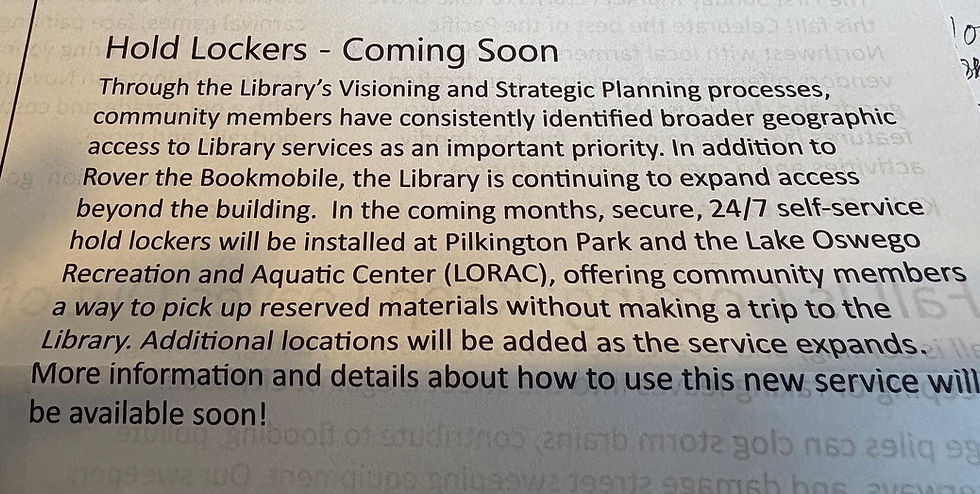
Just read this in Hello LO Sept 2026 Issue: the library is already starting to offer distribution services!
How is AI going to impact the future of library services?
6. What does “future” mean?
My blog post asks what Lake Oswego residents will need from their library 10, 20 and 30 years from now.
The City's response points out that Lake Oswego's population has grown substantially since the existing library was built. That's important. But population growth alone doesn't tell us what the future library should look like.
How are library services and library usage changing? What are people doing at libraries today that they weren't doing 20 years ago? What might they be doing 20 years from now?
A building that is too small for some current needs doesn't necessarily tell us what the optimal physical library looks like in 2040 or 2050.
Who is partnering with Library Manager Melissa (who is an expert on library content and services) who can compliment that with expertise in construction? And financial forecasting and scenario planning with trade-offs?
The City has several construction management experts. We just met Bruce from the Parks & Rec team - he said he has 30 years of experience in construction and has done LORAC, the Tennis Center and is now leading the construction of the Willamette River pathway.
Could a consultant or retired person with expertise in being a CFO/COO be part of Melissa's team on this project?
And finally: What do taxpayers actually want to pay for?
This is why I proposed an independent community survey.
I'm not saying: “Taxpayers don't want a new library.”
I'm saying: Let's find out.
Let's ask residents what library services they value, what problems they experience, what they would like to see in the future, how they use the library today, and what alternatives they would support funding. The survey done just asked what they wanted, not what they wanted to pay for.
A major public investment should begin with understanding the community's needs and priorities—not simply with deciding what building to construct.
I appreciate the City's response and look forward to seeing the additional financial information as it becomes available.
My hope is that we will determine what Lake Oswego needs first—and then determine the best, most financially responsible way to provide it.
Adding an analogy...
Let's shift the focus from “we need a new facility” to fully exploring the problems and possible solutions.
I learned this in my career doing web and software design.
In software development, you don’t start by building the biggest possible system. You first define the requirements and "jobs to be done"
You ask:
Who are the users?
What problems are they trying to solve?
What capabilities do they need?
What are the alternatives?
What is the minimum/optimal system?
Then you design the architecture.
For the library: Community requirements → service model → physical infrastructure.
Not: Building concept → fill it with services → find the money.
Imagine Lake Oswego saying: “People want books, so let’s build a gigantic warehouse.”
That would be absurd because the warehouse isn’t the service.
The service is getting people the books and resources they want.
You might use:
a central warehouse,
neighborhood pickup lockers,
delivery,
mobile vans,
digital books,
partner locations,
or some combination.
A library can be thought about similarly.
The question isn’t “How big should our library building be?”
It’s: “How should Lake Oswego provide library services to residents in 2030, 2040 and 2050?”
Then determine what physical infrastructure is required.
If we decide the answer is a building, then naturally we’ll spend our time figuring out what to put in the building. But if we start with the community’s needs, we may discover that some needs require a building, some require technology, some require partnerships, some require mobile services, and some may be best addressed in completely different ways.
I asked AI: future of library with distributed services vs one building
"The future of public libraries points toward a hybrid model where a central flagship building anchors a wide-reaching, distributed network of smart lockers, digital portals, and satellite stations. [1]
The One-Building Model (The Central Flagship)
Community Anchor: Provides a physical sanctuary for studying, civic gathering, free public Wi-Fi, and face-to-face assistance.
Resource Heavy: Centralizes large print collections, special archives, high-cost maker spaces, and professional staff under one roof.
High Fixed Costs: Suffers from high overhead for real estate, maintenance, and limited geographic reach for residents living far away. [1, 2, 3]
The Distributed Services Model (The Network Approach)
Hyper-Localized Access: Uses automated book kiosks, remote smart lockers in grocery stores or transit hubs, and pop-up digital services to meet people where they live. [1]
Flexibility & Reach: Scales access to tools, Wi-Fi hotspots, and physical materials across neighborhoods without building expensive full-scale branches. [1]
Operational Hurdles: Requires complex logistics for item delivery, digital infrastructure management, and maintaining consistent patron support. [1, 2]
The Future Balance
The Flagship Hub: The central building remains essential for complex research, community programs, and human-centered social services.
The Outpost Network: Distributed nodes handle routine pickups, drop-offs, and high-demand item sharing, expanding the library's footprint safely and affordably. [1, 2]"
Sources AI used:

I thought this was a particularly helpful article:
https://www.libraryjournal.com/story/building-a-more-connected-digital-future-for-libraries-lj260601
Blog readers:
Send your comments to me here
And/or contact the Visioning Team directly LibraryVisioning@ci.oswego.or.us


Comments