
Are you watering your BIG trees? Are you maintaining your trees now to reduce expensive tree work in the winter?
- Derrith Schmidt

- 7 hours ago
- 4 min read

We had Kevin Oakley, ISA Certified Arborist with our tree maintenance company Northwest Turf & Tree, out this week to give us an estimate for tree maintenance and he advised that we deep water all our big trees for 30 minutes using a hose every 2 weeks.
We also learned a lot about the trees we have from Kevin
"Wiring the trees together needs to have slack to let trees grow and some bend in the wind. If they are wired too tight it’s like someone using crutches forever who can’t walk."
"Leaves are like tree fingers. They convert sunlight to food. So you don't want to cut too many branches with leaves because the tree won't get enough food."
"A tree's roots are the circumference of their canopy."
"If we lighten the weight of the limbs, it brings the tree canopy in and reduces them falling in the winter."
"The big trees, especially the Red Cedars, need deep watering for 30 minutes every 2 weeks in the summer."
We have a little house surrounded by a lot of big trees. After Kevin told us what each tree was, we did a little online research about the trees.

Beech Tree
Online experts say, "The beech tree (genus Fagus) is a majestic, slow-growing deciduous shade tree famous for its distinctive smooth, silver-gray bark and massive, dense canopy. Has simple oval leaves with prominent parallel veins and serrated margins. Leaves turn brilliant yellow to bronze in autumn and often cling to the branches through winter. Produces "beechnuts," which are small, three-sided nuts enclosed in a prickly husk. They serve as a critical food source for wildlife like birds, squirrels, and chipmunks. Highly enduring giants that frequently live 200 to 400 years, reaching mature heights of 50 to 115 feet."
Western Red Cedar (we have 4 of them) - photo on the far right above

Online research says, "The western red cedar (Thuja plicata) is a colossal, long-lived evergreen conifer native to the Pacific Northwest of North America. Often referred to as the "Tree of Life," it holds immense cultural, ecological, and economic significance, reaching heights of 100 to 200 feet in the wild and living for over 1,000 years. Cones: Produces very small, egg-shaped cones that measure only about a half-inch long. They stand upright on the branches, resembling tiny wooden rosebuds when they open to shed seeds." (These things we used to call "nits". We find them everywhere in the yard.)
We had cables put in last year and this year they'll check and adjust them if needed. Apparently this has to be done every year.
Douglas Fir
Online experts say, "The Douglas fir (Pseudotsuga menziesii) is a majestic, fast-growing evergreen conifer native to western North America. Despite its common name, it is not a true fir (genus Abies); it belongs to its own unique genus, Pseudotsuga, which translates to "false hemlock." It is the state tree of Oregon and is one of the most economically vital timber species in the world."
Ours is apparently special according to Kevin because it has three trunks. We're paying for one of the tree crew to climb it up to the top to check the tree "Tree inspection for potential hazards / Remove dead broken or hazardous hanging branches from tree to a 1in diameter" It may need to have cables to hold the three trunks together.

Kousa Dogwood
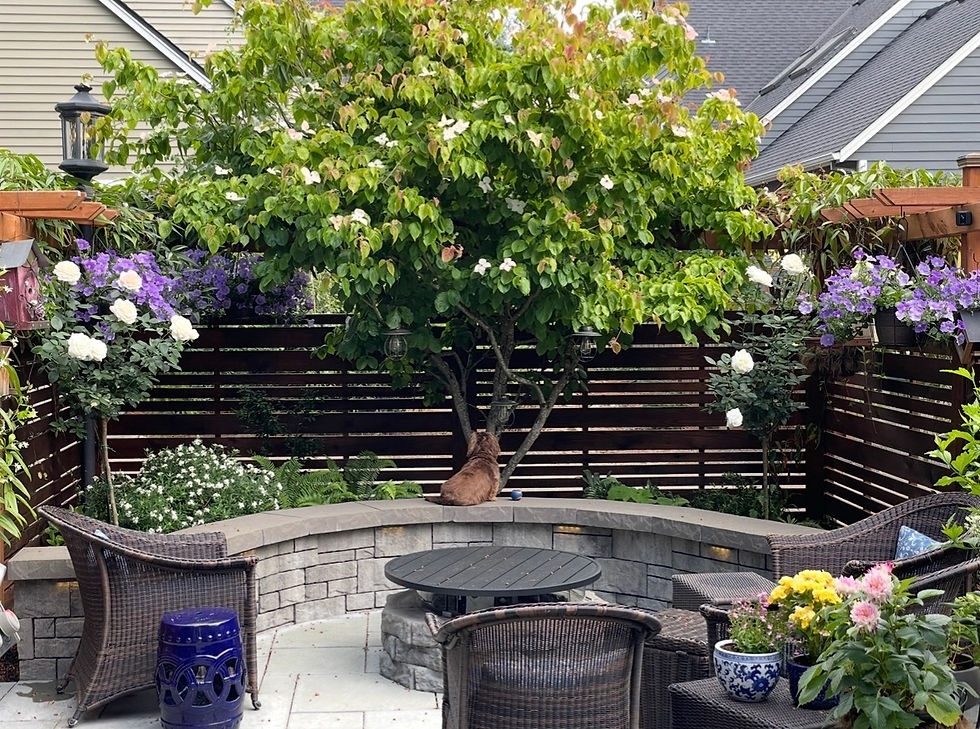
Online research says, "The dogwood tree (genus Cornus) is a highly popular, small-to-medium deciduous tree celebrated for its spectacular spring display, unique architecture, and vibrant autumn foliage. The "Flowers": The showy spring petals are not actually flower petals; they are modified leaves called bracts. The true flowers are the tiny green clusters nestled directly in the center of these large bracts."
We've tried to trim this tree and it looks like the equivalent of us cutting our own hair so last year we paid for a "Structure prune / Prune to shape for aesthetics" and we're doing it again this year.
Japanese Maples
For these they are going to "Building clearance 1-3ft depending tree species size and location / End weight reduction throughout canopy to prevent future breakage / Structure prune"

Thanks for sharing your expertise and analogies with us Kevin Oakley, ISA Certified Arborist, from Northwest Turf & Tree. Brett Swanson and his landscape team did the design and build of our courtyard, front and side yard. Best experience working with them! Their sister company that specializes in tree work has maintained our trees every year since 2020. We invest in tree maintenance during the fall to avoid expensive tree problems in the winter.
Related articles
Lots of Trees Are Being Cut Down by the City in response to the Emerald Ash Borer (EAB), a non-native, invasive wood-boring beetle that feeds on ash trees, eventually killing them.


Comments